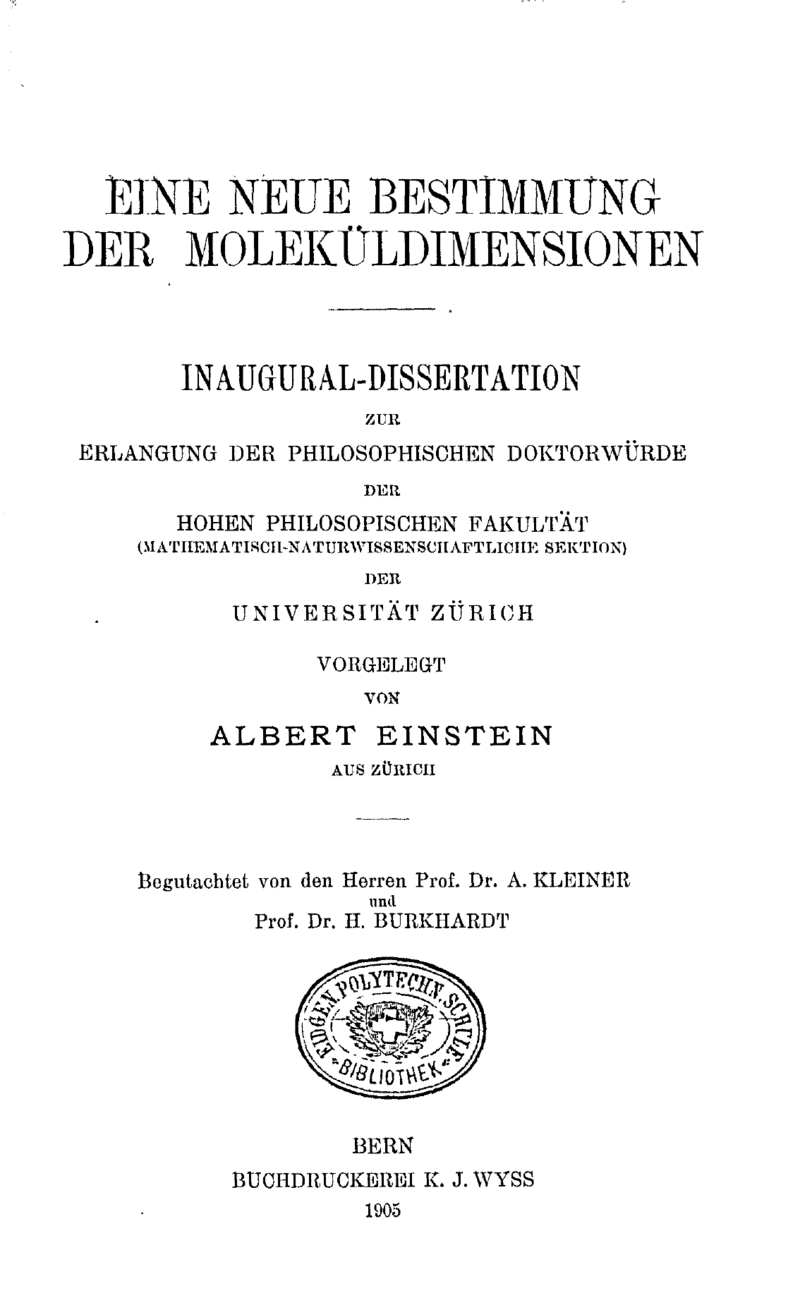
Einstein's PhD Thesis: Advancing Molecular Understanding through Statistical Mechanics.
German
Science
Academic
4 min read
Updated By: History Editorial Network (HEN)
Published:
Updated:
Albert Einstein's PhD thesis, "Eine neue Bestimmung der Moleküldimensionen" (A New Determination of Molecular Dimensions), explored methods for determining the size of sugar molecules and the number of such molecules in a given volume. This thesis was a critical step in understanding molecular behavior and properties using statistical mechanics.
Einstein's approach provided a way to measure Avogadro's constant with high precision. By analyzing the diffusion coefficients and observations on the Brownian motion, he was able to establish a more accurate method for calculating molecular dimensions. The work addressed the fundamental questions in physics related to the nature and behavior of atoms and molecules, which was a contentious topic among scientists at the time.
The completion and publication of this thesis marked a significant achievement in theoretical physics. It laid the groundwork for Einstein's later contributions, particularly in the areas of statistical mechanics and the theory of relativity. By refining experimental techniques and mathematical formulations, Einstein opened new avenues for the study of atomic theory and molecular kinetics.
Einstein's insights from this thesis contributed to the acceptance of atomic theory in physical sciences, providing empirical support through meticulous calculation and analysis. This work was a cornerstone in the development of both modern physics and chemistry.
#AlbertEinstein #Physics #MolecularDimensions #PhDThesis #ScienceHistory #MoofLife

Explore the Life Moments of
 AI Twin