Einstein–de Haas Effect: Conservation of Angular Momentum in Magnetic BodiesgetDisplay.
German
Science
4 min read
Updated By: History Editorial Network (HEN)
Published:
Updated:
Albert Einstein and Wander Johannes de Haas conducted an experiment, marking the pioneering observation of the Einstein–de Haas effect. This experimental discovery demonstrated the principles of the conservation of angular momentum in ferro-magnetic bodies. The experiment was central to physics as it provided empirical evidence that magnetic moments arise from the intrinsic angular momentum of electrons, also known as spin.
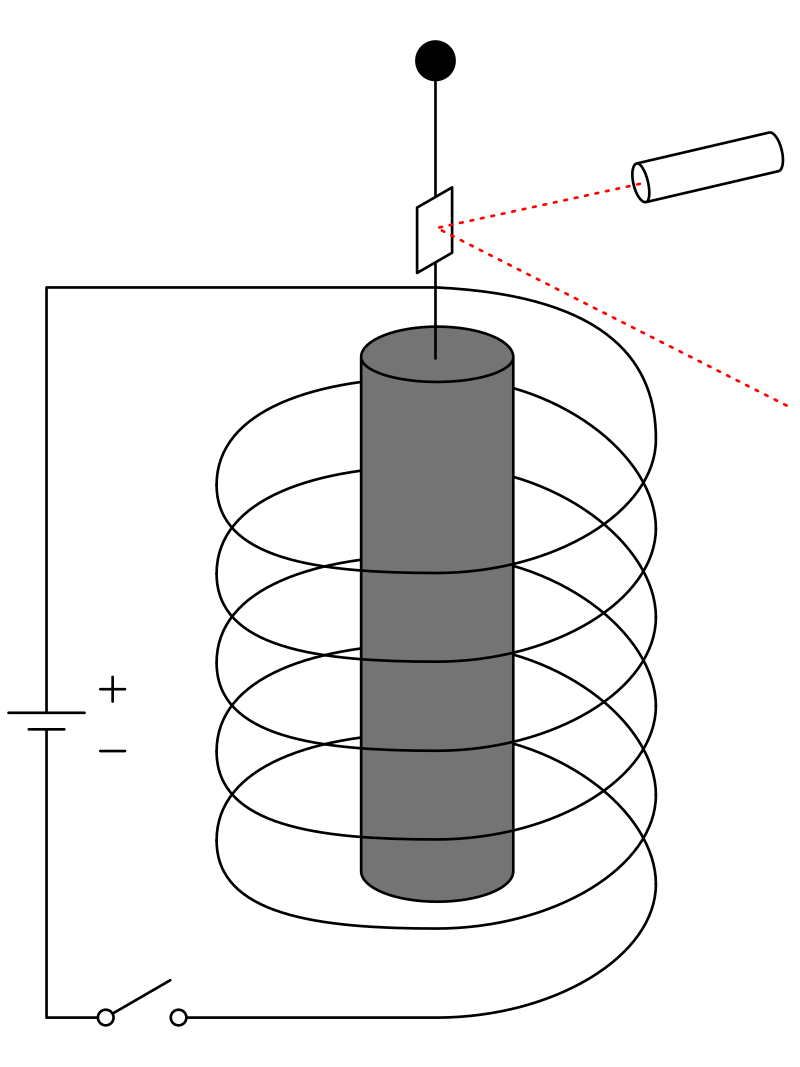
The setup involved suspending an iron cylinder within a coil and allowing a magnetic field to pass through the coil. When the magnetic field was applied, it resulted in a measurable rotation of the iron cylinder. The apparent torque generated opposed the change in magnetization of the iron, indicating the conservation of angular momentum. These results substantiated the then-emerging understanding of quantum mechanics and the behavior of electrons in magnetic fields.
By verifying that magnetic moments and angular momentum were directly connected, the experiment supported the quantum theory that magnetic properties at the atomic level could be explained by the motion of electrons. This experiment had far-reaching implications, influencing the development of various technologies, such as magnetic resonance imaging (MRI) and advancing fields like solid-state physics and materials science.
This observation also played a crucial role in reinforcing the theoretical predictions about atomic particles, interacting forces, and the broader framework of quantum mechanics. It underscored the importance of experimental physics in validating and shaping theoretical constructs, fortifying the bridge between abstract mathematical theories and observable physical phenomena.
#PhysicsHistory #QuantumMechanics #AlbertEinstein #ExperimentalPhysics #MoofLife
Explore the Life Moments of
 AI Twin