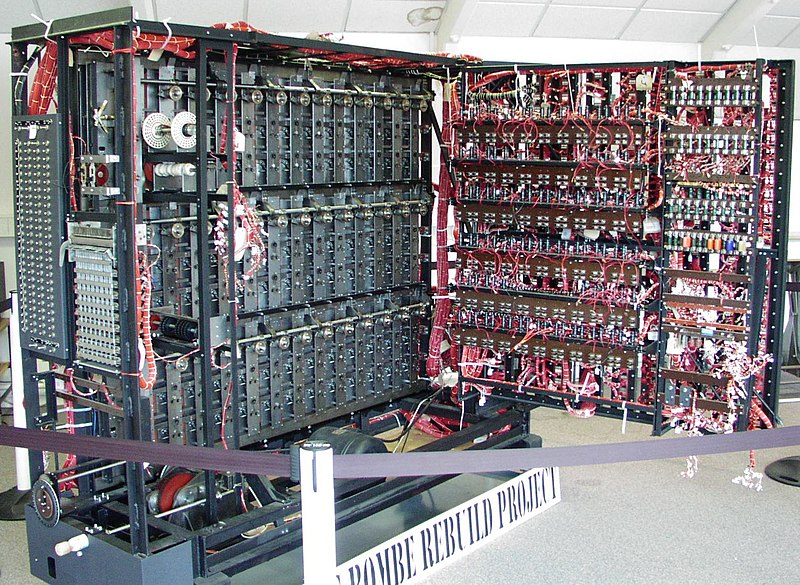
First Bombe Installed at Bletchley Park
United Kingdom
Cryptography
World War II History
Computer Science
4 min read
Updated By: History Editorial Network (HEN)
Published:
Updated:
The installation of the first Bombe at Bletchley Park marked a pivotal advancement in the efforts to decrypt Enigma-enciphered messages during World War II. Alan Turing, a mathematician and logician, designed this electromechanical machine to enhance the code-breaking capabilities that had been previously established by Polish cryptographers. The Bombe was specifically engineered to automate the process of searching for the correct settings used in Enigma messages, which were notoriously complex due to the machine's ability to produce a vast number of possible configurations. Turing's design was further improved by Gordon Welchman, who introduced enhancements that allowed the Bombe to perform logical deductions based on known plaintext, or cribs, which significantly increased its efficiency in ruling out incorrect settings. This capability enabled the Bombe to narrow down the possibilities, leaving only a few configurations for detailed investigation by human cryptanalysts.
The impact of the Bombe on the Allied war effort was profound. It facilitated the rapid decryption of critical military communications, providing intelligence that was crucial for strategic planning and operations. The ability to intercept and decode Enigma messages allowed the Allies to gain insights into German military movements and strategies, contributing to several key victories. The success of the Bombe at Bletchley Park not only underscored the importance of cryptography in modern warfare but also laid the groundwork for future developments in computing and artificial intelligence. The work conducted at Bletchley Park, particularly through the use of the Bombe, is often credited with shortening the war and saving countless lives, highlighting the essential role of technology in intelligence and military operations.
#mooflife
#MomentOfLife
#BletchleyPark
#AlanTuring
#Bombe
#Enigma
#Cryptography

Explore the Life Moments of
 AI Twin