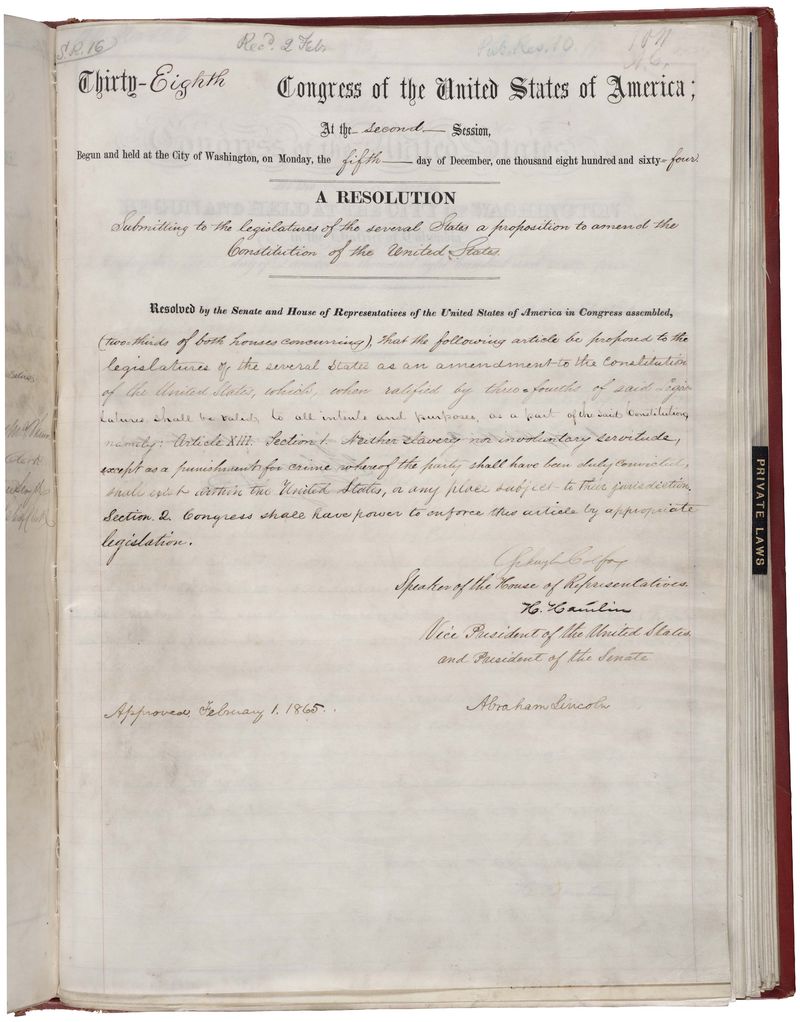
Ratification of the Thirteenth Amendment
United States
American History
Civil Rights
Legislation
4 min read
Updated By: History Editorial Network (HEN)
Published:
Updated:
The Thirteenth Amendment to the United States Constitution was a pivotal legal change that abolished slavery and involuntary servitude, except as punishment for crime. This amendment emerged in the context of the Civil War and the subsequent Reconstruction era, reflecting a significant shift in American social and legal norms. Following the re-election of President Abraham Lincoln, Congress passed the amendment, which was then ratified by three-fourths of the states. This process marked a crucial step in the United States' efforts to redefine citizenship and civil rights, particularly for formerly enslaved individuals. The amendment's passage was not merely a legal formality; it represented a fundamental transformation in the nation's approach to human rights and dignity.
The impact of the Thirteenth Amendment was profound and far-reaching. It legally ended the institution of slavery, which had been a cornerstone of the American economy and society, particularly in the Southern states. The abolition of slavery led to significant social changes, including the emergence of new labor systems and the gradual integration of formerly enslaved individuals into society. However, the amendment did not immediately resolve the issues of racial discrimination and inequality. Subsequent legislation and constitutional amendments were necessary to address the ongoing challenges faced by African Americans. The Thirteenth Amendment laid the groundwork for future civil rights advancements, influencing subsequent movements and legal battles aimed at achieving true equality and justice in the United States.
#mooflife
#MomentOfLife
#ThirteenthAmendment
#AbolitionOfSlavery
#CivilWar
#ReconstructionEra
#CivilRights
Primary Reference
Thirteenth Amendment to the United States Constitution

Explore the Life Moments of
 AI Twin